
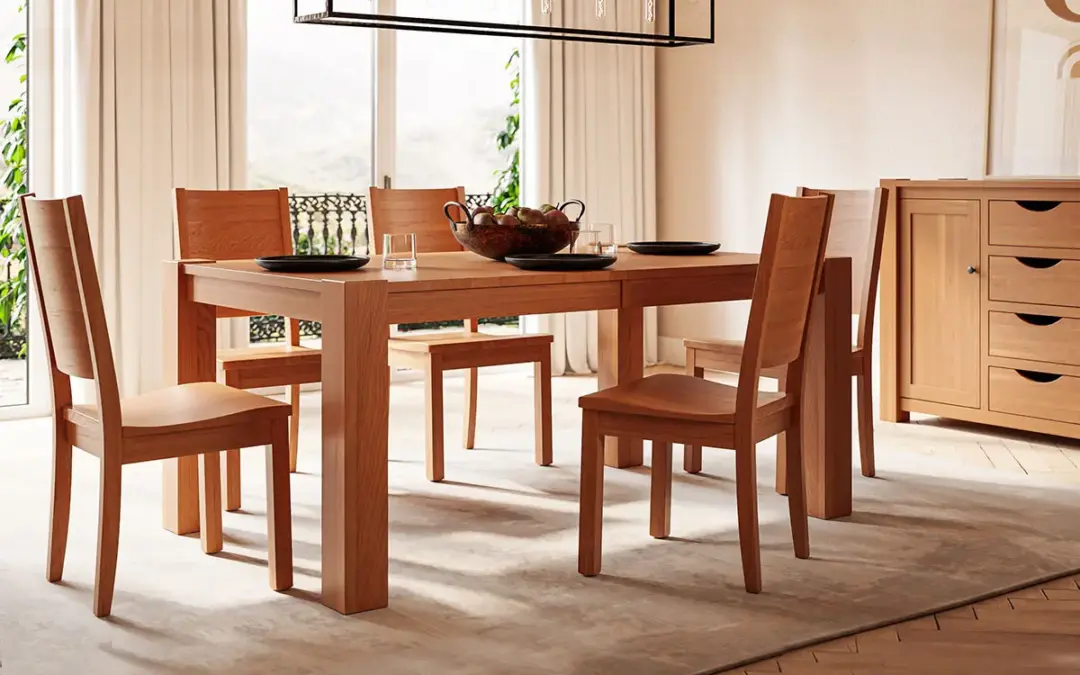
The dining table is the heart of the home. It is the place where dozens of family arguments unfold. It’s where you build memories and host countless Thanksgiving dinners. It’s the exact space where your kids laugh, learn, and grow right in front of your eyes. It’s not just another piece of furniture; it’s where life happens.
The dining table has to be aesthetically pleasing, but that’s not its only purpose. What’s more important is whether it’s built strong enough to withstand everyday use.
At Midwest Woodworks, our focus remains on building solid hardwood furniture that stands the test of time. Our skilled workers build Amish-made dining tables piece by piece, ensuring you receive the highest quality.
What Is an Amish Dining Table?
According to studies, many consumers today value engineered wood products like MDF and particleboard, which is why so much modern furniture is made of them. These mass-produced materials are low-cost and look contemporary and trendy.
But it comes with a trade-off: long-term durability.
Amish-made dining tables, on the other hand, aren’t defined by trends or factory labels. They are unique and built to last.
Handcrafted Construction
Amish-made dining tables are handcrafted. Every single piece is individually cut, fitted, and finished by skilled craftsmen.
The tiny details are considered and addressed, such as smoothing the edges, tightening the joints, and ensuring consistent, clean finishes. Nothing’s rushed in the manufacturing process; everything is checked and adjusted along the way.
Solid Hardwood Materials
The greatest difference between a traditional table and an Amish-made one lies in the materials used. Amish tables are made from solid hardwoods such as oak, cherry, maple, and walnut.
Unlike mass-produced options, which are crafted from veneers or particleboard, these are refined, which extends their lifespan. Also, since they are made of solid wood, they can be sanded and refinished over time, which again extends the furniture’s lifespan.
According to the USDA Forest Products Laboratory, solid hardwood has natural strength and better long-term performance in furniture construction, making it a winner for repeated daily use.
Made by Skilled Craftsmen
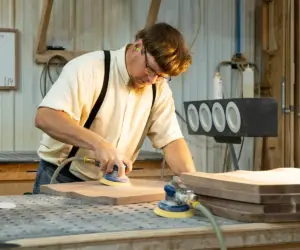
Amish furniture is built by expert artisans who have spent generations refining their skills. Amish woodworking is not an entry-level factory work; it’s a skilled craft passed down through families and communities.
This attribute gives us a consistent level of detail that’s hard to replicate. When you buy an Amish dining table, you’re not just buying the table; you are buying the experience and precision work of the person who has built it.
Traditional Woodworking Methods
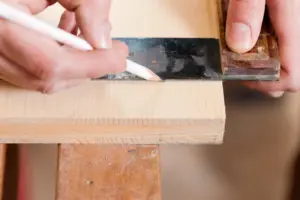
The Amish craftsmen also use the time-tested joinery techniques instead of relying on staples or quick adhesives. Methods like mortise-and-tenon and dovetail joints lock the pieces of wood together, giving the furniture stability.
The method reduces the stress on the joints and allows the wood to naturally expand and contract with the changes in temperature and humidity, keeping the pieces intact and strong.
Built-to-Order Options
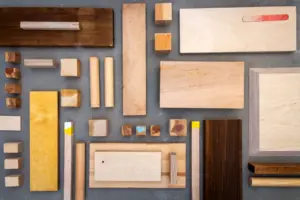
All Amish dining tables are built to order. You get to choose the table dimensions, the type of wood, stain, finish, and the leg styles. The end product is thus designed to fit your space and not the other way round.
Focus on Long-Term Durability
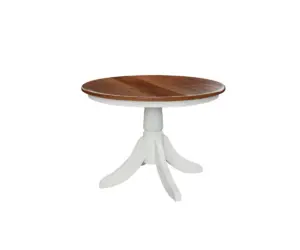
The Amish furniture is built to last despite everyday use. These are made of solid wood with reinforced joinery, so you won’t have to replace them every few years.
What Is a Mass-Produced Dining Table?
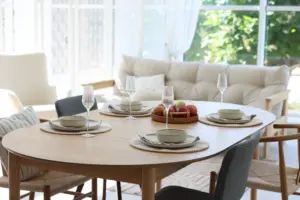
A mass-produced dining table is affordable furniture designed for speed and scale. These tables are manufactured in large volumes in assembly lines. They are automated, so they have standardized designs and are made from cost-efficient materials.
- Factory Production: The machines handle most of the cutting, shaping, and assembly, which allows the company to produce thousands of identical tables quickly. The only trade-off is that there’s less hands-on inspections and fewer adjustments.
- Standardized Sizes and Finishes: Mass production is about simple dimensions and pre-worked finishes. The process reduces the production cost and simplifies logistics. However, it leaves you with few sizes and limited color options.
- Faster Availability: Mass-produced tables are always in stock. They are ready to be shipped or picked up, since there’s no crafting or customization involved.
- Engineered Materials: Most of the mass-produced dining tables are made from engineered wood products such as MDF, particleboard, or thin wood veneers. Although these are the most common substrates, given their affordability and versatility, they are much weaker than solid wood.
- Designed for Broad Retail Appeal: Mass-produced tables are built to sell as many as possible. They are mostly neutral in design and simple in finish.
- Lower Upfront Price: Particleboard accounts for a large share of the furniture market, primarily due to its low cost and manufacturing efficiency.
Material Quality: Solid Hardwood vs Composite Materials
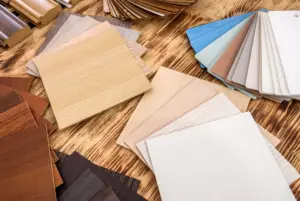
The real difference between Amish-made dining tables and mass-produced ones lies in the materials. A custom-made table versus a regular table may look exactly alike, but what’s hard to replicate is the wood itself.
The Amish dining tables are made from solid hardwoods such as oak, cherry, walnut, maple, or hickory. These are chosen given their density and grain structure, which gives them strength and longevity.
Also, solid hardwood has good screw-holding capacity and can handle weight and daily stressors without sagging. Over time, it develops a natural patina, but doesn’t break down.
The mass-produced dining tables, on the other hand, are manufactured from MDF (medium-density fibreboard), particleboard, veneer, or laminate.
These materials are cost-effective but not ideal for long-term performance.
Construction Differences
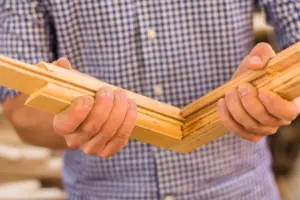
Amish craftsmen rely heavily on mortise-and-tenon joints. This gives Amish furniture a mechanical interlock that distributes stress across the joint rather than concentrating it.
That means an Amish dining table can hold repeated daily use. Whether it’s the kids climbing up top, logistics and shifting, or the pets rubbing against it as they pass by, it stands its ground.
Another feature of Amish furniture is the Dovetail joints, which again self-lock and give the drawers or extension points a strength boost.
Customization Options
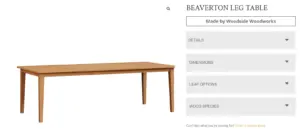
Amish-made dining tables are built around your designs. You can choose from a range of sizes, hardwoods, finishes, and matching pieces to completely customize the furniture according to your dining room.
This means you can customize the:
- Dimensions, including length, width, height, and shape
- Wood species such as oak, brown maple, cherry, red oak, quartersawn, or white oak
- Finish from dozens of stain options to match your floors, cabinets, and furniture
- Edge style such as bevel, mission, roundover, or ogee
- Straight legs, turned legs, or pedestal bases
- Dining chairs, benches, hutches or buffets, and cabinets
Style and Design Longevity
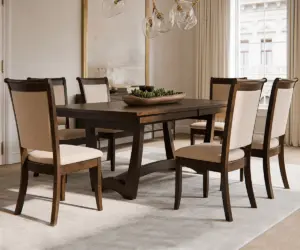
The Amish furniture design is highly influenced by the Shaker and Mission styles. It is simple, has a clean geometry, and most importantly, is functional. The tables do not have any excessive ornamentation; rather, they are balanced to fit right into any era.
Amish furniture does not chase trends. Whether you are buying Shaker-style, Mission-style, farmhouse, or modern Amish-style furniture, it just never looks old.
Whereas the mass-produced dining tables are often designed around Pinterest or showroom styles. These are mostly trendy, like ultra-gloss finishes that were ‘in’ a few years back, or overly stylized legs. That’s because they are designed for today and not for decades.
Durability and Everyday Family Use

A dining table is tested by what it can survive. Whether it’s the breakfast chaos or homework battles, spilled juice or the weekend feast, these are occasions where you can see the difference between an Amish-made dining table and a mass-produced one clearly.
Solid hardwood can handle the weight of laptops, notebooks, or hefty science projects. On holidays, you can host multiple dinners and serve heavy dishes, have your family unite over elbow-to-elbow seating, with people leaning on the edges. And your table setting won’t disappoint.
Spills, too, are very much expected in a running house. Since solid wood can be sanded and refinished over time, it means the surface damage is reversible. Particleboard, however, can swell or, worse, have its edges chip away due to these. The damage from them is usually permanent.
Price vs. Long-Term Value
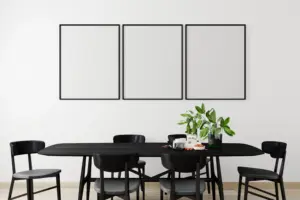
Most often, the dining table isn’t a one-time purchase. It’s something you live with daily, so the cost shouldn’t be analyzed on a day-to-day basis, but rather over the next 10 to 20 years.
Even though mass-produced tables win at the upfront price, solid wood furniture gives you premium hardwood, skilled craftsmanship, and a time-intensive construction.
The joints can be tightened, scratches can be sanded, and dents can be repaired when you have solid wood. Whereas the mass-produced tables do not have a second life.
Which Dining Table Is Right for You?
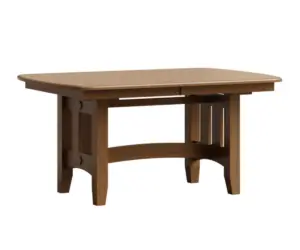
Buying a dining table is not a right-or-wrong decision. It’s more about lifestyle and your timing. Both mass-produced tables and Amish-made dining tables serve a purpose, and the key is to know which matches your current situation.
If budget is the main concern, or you are furnishing a rental space or a short-term home, mass-produced tables make sense.
However, if you value long-term durability and want a table that can become part of your daily life, where you serve multiple meals in a day, look into homework, host gatherings, etc., you need solid hardwood construction or Amish furniture.
Simply ask yourself whether you want a table for now or a table for life at home. Your answer will make the decision for you.
Final word
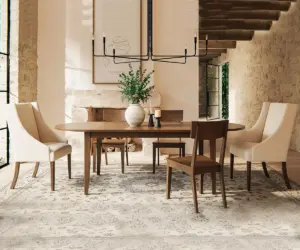
Furniture is not just about filling your space. It’s about how your space lives and performs.
When you compare an Amish-made dining table to mass-produced options, the difference goes beyond appeal and looks. It comes down to the craftsmanship, materials, strength, and long-term durability. On the one hand, you get speed and affordability, on the other, there’s precise manufacturing and designs built to last generations.
Make the choice that best fits your home and life. Explore our designs at Midwest Woodworks and invest in a dining table that works for today and tomorrow.